Your first job in Hell Let Loose: Vietnam is not to chase kills. Join a squad, choose a role you can support, make sure voice communication works, spawn with a purpose and move with other players.
The game is built around 50v50 matches, a chain of command and roles with different responsibilities. The US Forces and North Vietnamese Army also solve movement and logistics differently. That means a new player who communicates and follows the squad’s plan can be useful before mastering every weapon or map.
This is a pre-release guide based on confirmed systems and official playtest information. Exact controls, cooldowns, loadouts and balance may change before the August 13 launch. Sections that require the final build are marked for launch verification.
The five-minute version
For your first match:
- Check that your microphone and push-to-talk controls work.
- Join an active infantry squad instead of creating a squad you are not ready to lead.
- Choose a straightforward non-command role.
- Spawn near your squad and ask what it needs.
- Slow down near contact, watch where teammates are looking and help the squad’s objective.
If you remember only one rule, use this one: do not turn a 50-player team game into a solo walk through the jungle.
Before you join a server
Check whether your PC is ready
Steam currently publishes minimum and recommended PC specifications with official targets of 1080p/60 and 1440p/60. Those targets are marked subject to change. Compare your hardware with our Hell Let Loose: Vietnam system requirements page before troubleshooting performance in the middle of a match.
Set up communication
Official July playtest notes said HLLV had moved to Epic Online Services voice chat and identified distortion as a priority issue in that test build. Do not assume silence means your squad is ignoring you. Confirm the correct input device, push-to-talk binding and channel before the match becomes busy.
The July playtest behavior is not guaranteed to be the final launch setup. Our servers, crossplay and voice chat guide keeps playtest facts separate from launch verification.
Use a stable baseline
Start with a conservative graphics preset that gives you a stable frame rate and a clear image. Change one setting at a time. Copying a beta preset from another PC can make diagnosis harder because the hardware, resolution and build may be different.
Choose a role you can support
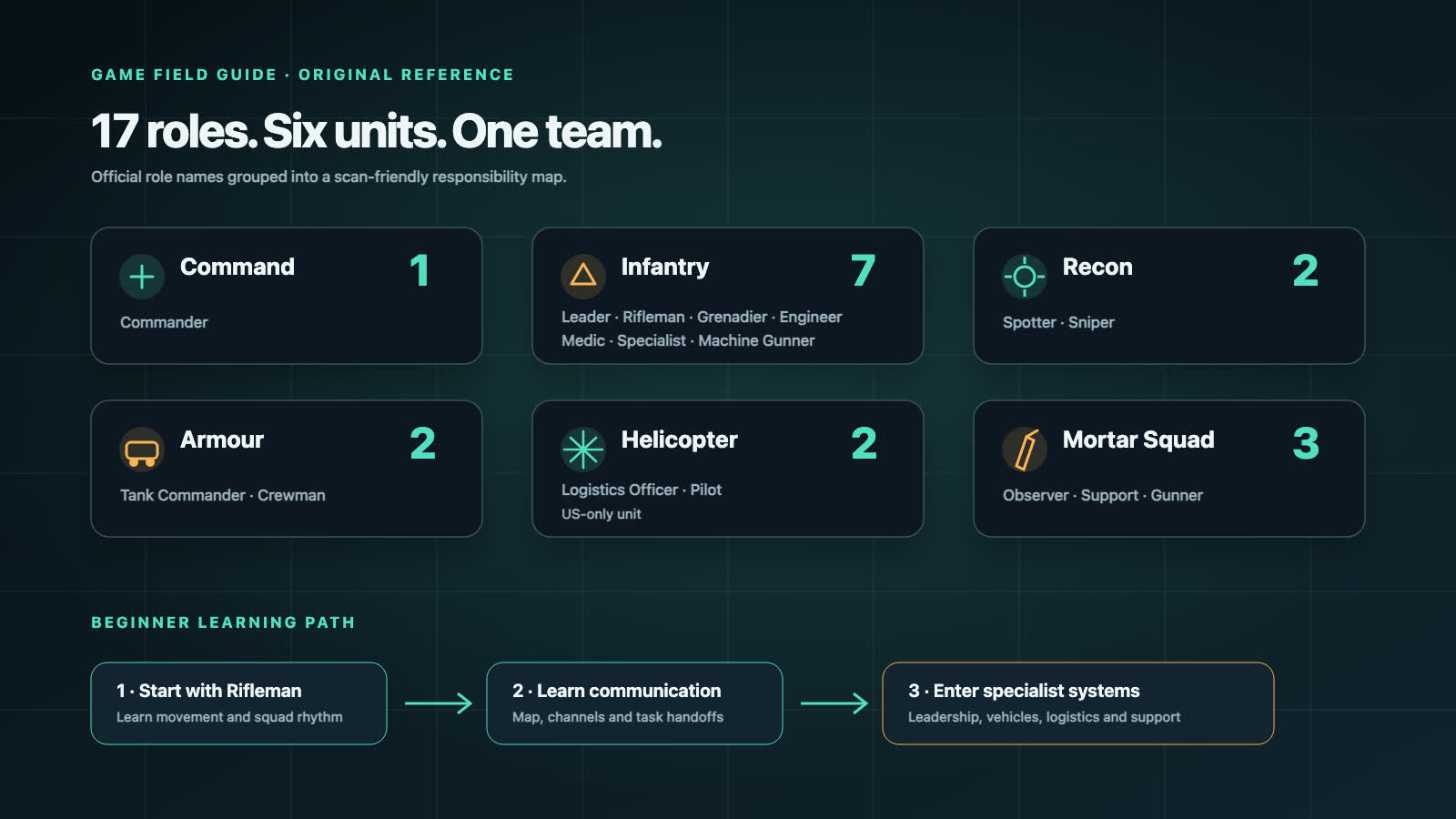
The official Steam listing names 17 roles across six battlefield units:
- Command: Commander.
- Infantry: Squad Leader, Rifleman, Grenadier, Engineer, Medic, Specialist and Machine Gunner.
- Recon: Spotter and Sniper.
- Armour: Tank Commander and Crewman.
- Helicopter, US only: Logistics Officer and Pilot.
- Mortar Squad: Observer, Support and Gunner.
For a first match, begin in an infantry squad and avoid taking Commander, Squad Leader, Pilot or another coordination-heavy role unless the team specifically needs you to learn it with guidance. A scarce specialist seat can affect more than your own match.
The exact beginner recommendation will be rechecked against the launch build. For now, choose a role whose job you can explain in one sentence and tell your squad you are new.
See the roles and classes guide for the full responsibility matrix.
Spawn with a reason
Before pressing deploy, ask:
- Where is my squad?
- Is it attacking, defending or rebuilding?
- Is this spawn likely to send me into the same failed route?
- Does the squad need supplies, defence or another body at the objective?
Spawning closest to the enemy is not automatically the best choice. A spawn that keeps you connected to the squad may save more time than a forward spawn that leaves you isolated.
The final spawn interface and placement rules need launch-build verification. The decision principle is stable: choose the spawn that supports the squad’s next task.
Communicate without filling every second
Good communication is short and useful.
Use this pattern:
What you saw → where it is → what it is doing.
For example: “Infantry crossing the river, east of our position, moving north.”
Avoid calling every distant sound an enemy position. If you are unsure, say so. A qualified callout helps the squad judge risk; an overconfident wrong call can redirect everyone.
Keep social conversation out of a busy channel when the squad is coordinating a move. Listen for the Squad Leader’s plan, confirm only what needs confirmation and report information that changes the decision.
Move as if visibility is part of the weapon system
Dense vegetation and uneven terrain make speed expensive. Sprinting can reduce the time you have to notice movement and increase the distance between you and the squad.
When the squad approaches likely contact:
- reduce speed;
- use cover that breaks your outline;
- stop crossing open ground one player at a time;
- watch the direction of friendly fire and movement;
- move after the squad has identified the next piece of cover.
This is editorial tactical guidance, not a promise about a hidden visibility statistic.
Read the team before reading the enemy
Your teammates provide information even when nobody speaks.
- A cluster of stationary friendlies may be defending, pinned or waiting for support.
- Repeated deaths from the same approach suggest the route needs to change.
- A squad moving together usually has more context than a lone player sprinting past.
- Vehicle and helicopter movement can reveal the team’s logistics plan.
Use the tactical map to connect those clues with terrain. The developers say HLLV’s 3D tactical map is generated from the game world and is intended to make hills, valleys, roads, rivers and obstacles easier to understand. Our tactical map guide will add verified controls after launch.
Understand the two factions
HLLV is deliberately asymmetric. The official developer Q&A describes different logistical strengths rather than mirrored teams.
- The US Forces use helicopters to move troops and supplies.
- NVA forces use tunnel networks and can use boats to move supplies through waterways.
- Both factions have comparable weapon classes, but the developer says individual weapons differ in handling, recoil and ammunition capacity.
Do not copy the other faction’s movement pattern without thinking. The team’s available logistics change which routes are sustainable and how quickly a new position can be supported.
Read the US Forces vs NVA comparison before taking a faction-specific logistics role.
Help with the objective, not only the scoreboard
The official store description emphasizes chain of command, teamwork and objectives. A useful first match can include:
- defending an approach while the squad moves;
- carrying or placing a resource your role is responsible for;
- reporting a threat;
- staying alive long enough to maintain pressure;
- helping a teammate recover;
- joining the squad’s coordinated route instead of opening another isolated fight.
Do not use kill count as the only measure of whether a role is working. If your action lets the squad spawn, move, hold or communicate, it may have more match value than one additional elimination.
Common first-match mistakes
Taking command without knowing the interface
Leadership is learnable, but your first live match is a poor time to discover every command tool while the team waits. Start by listening to competent leadership and learning the information they ask for.
Spawning repeatedly into the same failure
If the same route produces the same result, pause. Check the map, ask for another approach and wait for teammates.
Treating voice problems as a social problem
The July playtest had an acknowledged VOIP distortion issue. Test devices and channels before assuming other players are refusing to respond.
Copying settings without measuring
A preset from another player may target different hardware and resolution. Record the current state, change one item and compare the same type of scene.
Publishing beta knowledge as permanent knowledge
This mistake applies to guides as well as players. Balance, controls, server behavior and map readability can change. Check the page’s last-verified date before relying on an exact procedure.
First-match checklist
Before deployment
- My input device and push-to-talk binding are correct.
- My frame rate and connection appear stable enough to test.
- I joined a squad instead of creating an unsupported leadership slot.
- I chose a role whose responsibility I understand.
After spawning
- I know whether the squad is attacking, defending or supporting logistics.
- I am moving with at least part of the squad.
- I checked the tactical map before crossing a major open route.
- My callouts describe what, where and direction.
- I will change route if the same approach fails repeatedly.
Before changing role
- The squad actually needs the new role.
- I understand its communication and logistics responsibility.
- I am not abandoning equipment or a task the squad is relying on.
What we will verify at launch
This page will be reviewed against the August 13 build for:
- default controls and radio behavior;
- final server and crossplay options;
- role equipment and beginner suitability;
- spawn interface and deployable terminology;
- tactical map controls and markers;
- performance-sensitive setup steps.
Sources
- Hell Let Loose: Vietnam on Steam
- Crossplay Playtest: Known Issues, Feedback & Info
- Dev Q&A #1: Performance, Gameplay & Maps
- Official Hell Let Loose news
Game Field Guide is independent and is not affiliated with Team17 or Expression Games.
Return to the Hell Let Loose: Vietnam guide hub for the complete launch checklist and all verified guides.